Labels

Showing posts with label A2 Philosophy. Show all posts

Friday, 24 February 2012

Rowan Williams and Richard Dawkins in Oxford argument

The importance of matters of Theology were reinforced again this week in a debate between prominent atheist Richard Dawkins and the Arch Bishop of Canterbury Rowan Williams.


This is in the light of claims from the likes of Dawkins that religion should be an entirely private matter and should have no place in public life. He would like to see the removal of unelected Bishops from the House of Lords and the eradication of faith schools that are partly funded by the state.


This particular debate however covered the issue of the soul, which Dawkins rejects and Williams accepts; evolution, which they both accept; and the problem of evil, that they both agree is a serious issue for those who believe in God.

Tuesday, 20 September 2011

A2 Theology Essay Competition

Enrich your subject knowledge and understanding
Improve your exam skills
Excellent way to enhance your UCAS personal statement


Essay of no more than 1000 words


‘There is nothing beyond the physical world.’ Discuss


Must be handed in/emailed to your Theology teacher by Monday 17th October

1st Prize £30

Wednesday, 18 May 2011

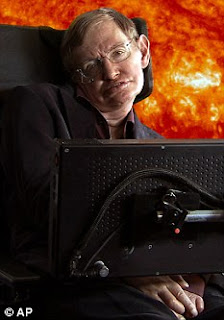
Life After Death is a 'Fairy Story' say Stephen Hawking

Emminent scientist Stephen Hawking has branded life after death a 'fairy story for people who are afraid of the dark'. He has also recently proposed that the universe could create itself from nothing, with out the need of God - see here.


Hawking's understanding of the workings of the universe is, to be sure, greater than most of us could ever wish to hold, but is knowledge of the universe enough to deny out right the existence of life after death? Talk of life after death is generally regarded as belonging to the realm of metaphyics, philosophy and Theology. It's true that science hasn't provided any convincing evidence for life after, however it has long been suggested that if there is a heaven, or indeed a hell, that it would be transcendant, that is beyond time and space beyond the universe. The idea of a heaven in the sky and hell under the earth is viewed by most, in metaphorical or symbolic terms.


Hawkings also likens the human brain to a computer, that shuts down at death. I can only assume that he is making use of analogy here as, while there are obvious similarities between a brain and a computer eg, the ability to store and retrieve information, that are also vast differences. It was the famous sceptical agnostic philosopher Hume who criticised Paley's watch analogy on this very point. Just because the brain resembles a computer in some ways, it does not follow that it resembles it in all ways. The Dualist view is that we are more than simply physical matter - and that it is reductionist to suggest that the people we are, our feelings, desires, memories, fears and loves are nothing more than the result of a complex biological computer.
There are good arguments against the existence of life after death as well as arguments to support it but many of them go beyond the remit of science.


There is a danger when scientists like Hawking make metaphysical/philosophical claims and that many people will accept them as scientific fact, when, in truth the issue is very much up for debate.


To read more from this article click here.

To read more on life after death click here.

Tuesday, 7 December 2010

Faking A Religious Experience

This documentary shows how stimulating the brain in a certain way can produce an experience with very similar characteristics to those of a religious experience.
Does this show that religious experiences cannot be genuine?
I don't think it goes that far. It does show that a scientific explanation of the experiences is possible and as such, bring more doubt as to the authenticity of such experiences but it doesn't prove they are not genuine.
After all, taking hallucinagenic drugs may make you see beautiful butterflies flying in front of your eyes, but this does not mean that whenever anyone claims to see beautiful butterflies that we must assume that the butterflies are not real.


For more on religious experiences click here.

Wednesday, 20 October 2010

How far can we trust our senses?

In his Cave Analogy Plato compares empirical knowledge to imperfect flickering shadows. He argues that our physical senses cannot be trusted and reveal the truth to us.

More modern Materialists, such as Richard Dawkins, have more sympathy with Aristotle's view that it is only through scientific empirical evidence that we can know anything.

The BBC documentary Is Seeing Believing explores how our senses can be misled and manipulated and, also, why this may not necessarily be a bad thing.


To watch more from this programme click here.
For more on Plato's Cave Analogy click here.

Wednesday, 22 September 2010

Professor Keith Ward discussing Materialism and Idealism

Keith Ward: "Why There Almost Certainly Is a God: Doubting Dawkins from Metanexus Institute on Vimeo.

Keith Ward is seen here challenging the claims of Hard Materialists like Richard Dawkins, that the universe and everything in it is purely physical.

Some good notes regarding the body and soul argument can also be found here.

This would be particulalry useful for the Body and Soul module and anyone taking part in the A2 essay competition.

Friday, 2 July 2010

A2 Theology Essay Competition

Enrich your subject knowledge and understanding
Improve your exam skills
Excellent way to enhance your UCAS personal statement
Essay of no more than 1000 words
‘There is nothing beyond the physical world.’ Discuss
Must be handed in/emailed to your Theology teacher by Monday 18th October

1st Prize £30 HMV voucher
Runner up prize £15 HMV vouchers
For more details see Mr Vaughan

Tuesday, 10 November 2009

'Miracle Cure' attributed to Cardinal Newman

American deacon, Jack Sullivan, claims to have been cured of debilitating back pain through the intervention of the late Cardinal John Henry Newman.


Newman was a 19th Century English Bishop, who converted to Catholicism from the Church of England at the age of 44.


He is respected as a theologian and for his work with the poor.


The miracle has been accepted by the Vatican and puts Newman on the path to Sainthood.

Read more here.


For learning resources and information about miracles click here.

Thursday, 15 October 2009

Interpreting The Bible


How the Bible is to be read and understood is by no means a simple matter.

There are a number of different ways of approaching the Bible and different Christian denominations will advocate one method over another.

This matter is further complicated by the huge variety of types of literature in the Bible, the different authors and the huge timescale over which the different books were written.


Some propose the Bible must be taken literally. This creates problems however as there are apparant contradictions and it also, for example, is very difficult to make this compatible with a scientific view of the world.


Others will suggest that many of the Biblical books should be read as myths that still, however, contain truths about God's relationship with humanity. While this may explain some of the contradictions and be compatible with science it does mean that the meaning of these myths is based on human judgement and could vary from person to person or denomination to denomination.


Read more here and here.


Thursday, 1 October 2009

Is religious experience a link to the Divine or a trick of the mind?


The University of Wales in Lampeter houses the Religious Experience Research Centre that has records of thousands of spiritual, religious or unexplained experiences.


Many claim these experiences have rational explanations connected to brain activity while others believe they may be a genuine experience of the spiritual or divine.


Find out more in a short article from the Metro here.


Visit the Religious Experince Research Centre here to take their survey.